
US President Andrew Jackson Signed Autograph Letter ALS 1844 PSA Auth Framed


Original Handwritten & Signed Letter · 1844. Seventh President of the United States. Original Handwritten & Signed Letter.
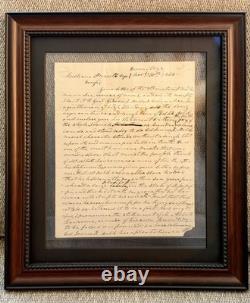
Dated November 30, 1844 · Written on both sides Jackson's defense of James K. Includes the original full PSA Letter of Authentication. Original Andrew Jackson letter: handwritten and signed by Jackson, dated November 30, 1844; one sheet written on both sides. Complete professional frame: double-sided display with museum glass and 99% UV protection.The letter comes already framed. Original full PSA Letter of Authentication (LOA): included with the framed manuscript. PSA certification: AS06127 · Verify directly with PSA.
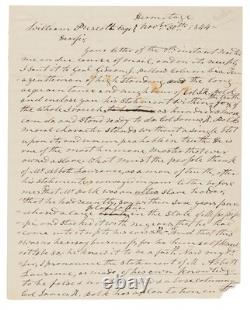
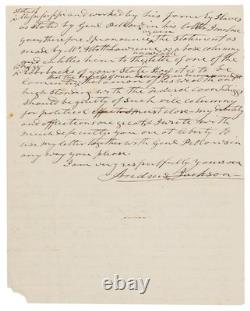
See the listing photographs for the actual finished frame and authentication document. The manuscript images below show the letter before framing. The original manuscript, entirely in Jackson's hand, with his signature at the close. The opening and the defense of Polk. The verdict on Abbott Lawrence, and Jackson's signature. These images show the manuscript before framing. See the listing photographs for the finished frame, front and back. Signature detail · November 30, 1844. A closer look at Jackson's signature at the close of the letter. Detail photograph of the manuscript offered in this listing. Andrew Jackson, 7th President of the United States. Autograph Letter Signed (ALS), entirely in Jackson's hand. Defense of President-elect James K.Polk against charges by Whig leader Abbott Lawrence. One sheet, written on both sides.
7.5 × 9.75 inches. Fine; small stains and minor corner loss. Please review all listing photographs for paper, ink, edges, folds, and frame condition.
PSA; original full Letter of Authentication (LOA) included. Comes fully and professionally framed; double-sided display with museum glass and 99% UV protection. Full PSA Letter of Authentication Included.
The framed manuscript comes with its original full PSA Letter of Authentication (LOA). Please review the listing photographs of the letter, finished frame, and PSA document. Verify the certification directly with PSA. Visit PSA's certification lookup and enter certification number AS06127 to review PSA's record. Check AS06127 on PSA's website?Original Manuscript · Professional Framing · PSA Documentation. Old Hickory Defends Young Hickory.
Dated November 30, 1844, this letter captures Andrew Jackson defending James K. Polk in the aftermath of the presidential election. Writing to William Prescott, Jackson rejects allegations attributed to Abbott Lawrence and invokes a statement from Gideon J. Pillow in support of Polk.The force of Jackson's language gives the letter its character. He calls the allegation "false & unfounded & a base calumny" and labels Lawrence one of the Whigg Roorbacks. This is substantive political correspondence, with named figures, a specific dispute, and Jackson's own emphatic judgment. The letter explicitly discusses Polk's ownership of enslaved people and a Mississippi plantation.
Jackson's defense reflects the proslavery attitudes of its author and era. That content is central to the document's historical significance. The closing shifts from political anger to personal frailty: my debility and afflictions are great, & I write with much difficulty. It is a striking passage in a letter from the final months of Jackson's life.
A gentleman of high standing, of long acquaintance and neighbour of Col. Polk and enclose you his statement within, for the truth of the whole I vouch, as hundreds more can do, and stand ready to do. Polk's moral character stands without a single blot upon it, and unimpeachable in truth.He is one of the most humane Masters that ever owned a slave. What must the people think of Mr. Abbott Lawrence, as a man of truth, after his statement, (as conveyed in your letter before me) that Mr. And that this was no hearsay business, for he himself knew it to be so, he knew it to be a fact.
Sir, I pronounce the statement of Mr. Abbott Lawrence, as made of his own knowledge to be false & unfounded & a base calumny. Polk has a plantation in the State of Mississippi and worked by his family slaves as stated by Gen'l Pillow in his letter I enclose you, therefore I pronounce again the statement as made by Mr. Abbott Lawrence as a base calumny and entitles him to the unenviable title of one of the Whigg Roorbacks. How is it to be lamented that the morals of men recently are become so corrupt, that a man of his wealth and a high standing with the Federal Coon Whiggs.Should be guilty of such vile calumny for political effect. I must close-my debility and afflictions are great, & I write with much difficulty. You are at liberty to use my letter together with Genl Pillows in any way you please.
Roorback: a campaign smear, after the fictitious "Baron Roorback" travelogue circulated against Polk in 1844. Federal Coon Whiggs: the raccoon was the Whig Party's popular emblem in the 1840s, and Democrats called Whigs "Federal" to tie them to the old Federalist Party.
Transcription supplied for reading convenience. Refer to the manuscript photographs for the original text; historical language is retained. Framed for Viewing Both Sides. Museum glass presents the manuscript clearly within its professional frame. Glazing with 99% UV protection helps reduce UV exposure. Display away from direct sunlight.View the opening, continuation, and signature without removing the letter from its frame. The Man Behind the Manuscript. Known as "Old Hickory, " Andrew Jackson rose from a frontier upbringing to become a Tennessee lawyer, military commander, and the seventh president of the United States.
His victory over British forces at New Orleans made him a national figure. In office, Jackson strengthened presidential power, fought the Second Bank of the United States, and confronted South Carolina over nullification. His legacy also includes slaveholding and the Indian Removal Act of 1830, which helped drive the forced displacement of Native peoples. He retired to the Hermitage in Tennessee and died on June 8, 1845. This November 1844 letter belongs to the final months of his life. Biographical sources: White House Historical Association; archived White House presidential biography. Historic portraits are included for illustration and are not part of the sale. Portrait sources: Wikimedia Commons, White House Collection, and Smithsonian American Art Museum.Both portrait reproductions are public domain in the United States. History in Jackson's Own Hand. Original handwritten and signed Andrew Jackson letter, delivered fully framed with its original full PSA Letter of Authentication.
Double-sided display with museum glass and 99% UV protection. Please review all listing photographs before purchasing.